How a retreat at a sleepy seaside resort in Thailand led to ASEAN’s formation
AUG 5, 2026
|
7-MIN
READ
Today, ASEAN has 11 member states and is approaching its 60th
anniversary in 2027.
From its original five members, the regional organisation has steadily
expanded and is now set to become the world's fourth largest economy
by 2030.
Although a stable regional alliance today, its origins were, in fact,
fraught with uncertainty. It all started with one document from 1967 –
the Bangkok declaration, which would later be known as the ASEAN
declaration – that set the stage for regional cooperation.
August 1967
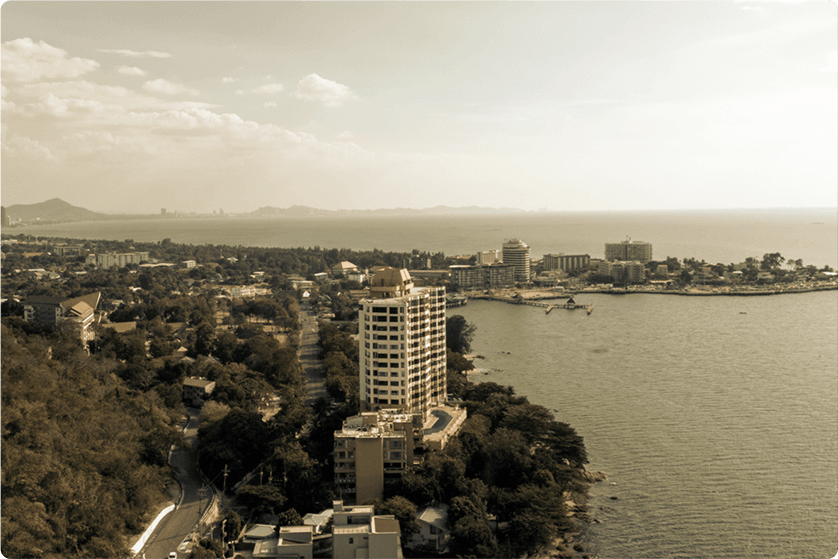
Five ministers gathered in Bang Saen, a coastal resort town located
over an hour's drive from Bangkok.
Bang Saen, Thailand.
They included Indonesia's Adam Malik, the Philippines' Narciso R.
Ramos, Malaysia's Tun Abdul Razak, Singapore's S. Rajaratnam, and
Thailand's Thanat Khoman. Only twenty-four hours earlier, they had
convened at the Thai Ministry of Foreign Affairs for their first
official meeting, to lay the groundwork for a new association for
cooperation.
Southeast Asia in the 1960s was fractured by geopolitical rivalries
and territorial conflicts, leaving relationships between neighbouring
nations strained. As these tensions threatened to boil over, the
leaders recognised that mutual cooperation and political stability
were vital for the region's survival.
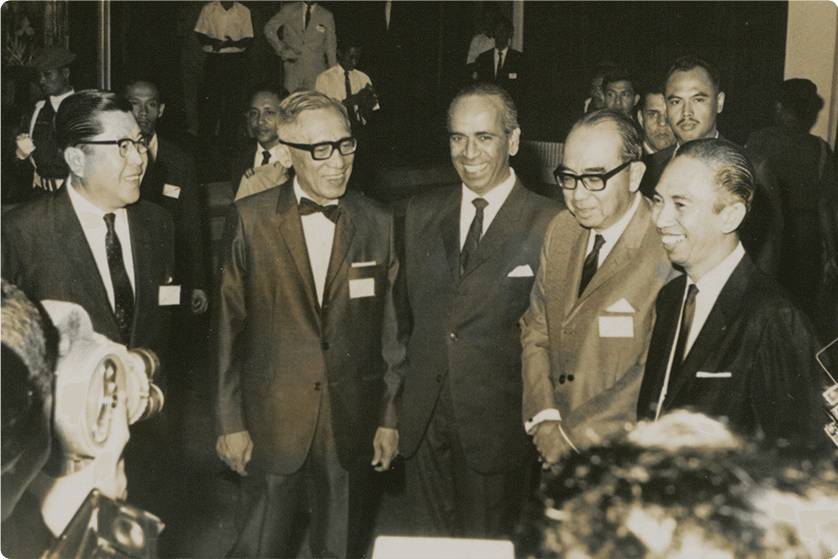
Yet, launching a unified initiative proved tricky.
Ministry of Information and the Arts Collection, courtesy of
National Archives of Singapore.
After four days of informal discussions at a seaside resort, the
ministers reached a breakthrough in their negotiations. The ultimate
icebreaker? Playing golf.
As they walked the fairways, they debated, negotiated and refined the
agreement's details in what would later be dubbed "sports shirt
diplomacy".
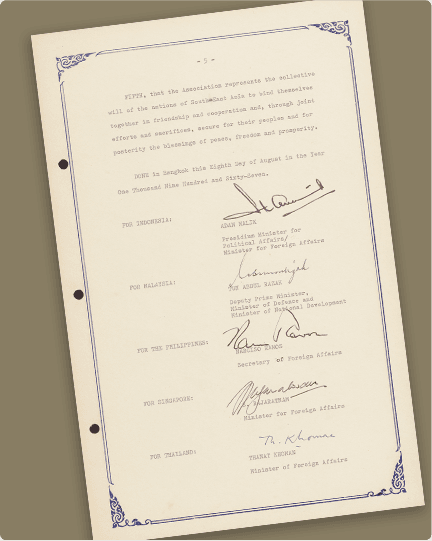
Following the retreat, the leaders returned to Bangkok to sign the
historic Bangkok Declaration, the founding document that established
the Association of Southeast Asian Nations (ASEAN).
On August 8, 1967, ASEAN was born.
Cabinet Office Collection, courtesy of National Archives of
Singapore.
We must now think at two levels. We must think not only of our
national interests but posit them against regional interests: That is the new way of thinking about our
problems.Share quote
From a statement by S. Rajaratnam, Minister for Foreign
Affairs, in Bangkok, August 8, 1967.
As geopolitical tensions stabilised, it was time to look at closer
economic cooperation.
1977: Foundations of an ASEAN trading bloc
ASEAN Agreement on Preferential Trading Arrangements
This agreement established the foundational framework for intra-ASEAN
trade liberalisation, extending preferential tariff treatment on
selected products among member states, including mechanisms such as
long-term quantity contracts and liberalisation of non-tariff
measures.
It laid the foundation for deeper regional economic integration,
paving the way for the creation of a more comprehensive ASEAN trading
bloc in the 1990s.
1992: Further eliminating tariff barriers
ASEAN Free Trade Area
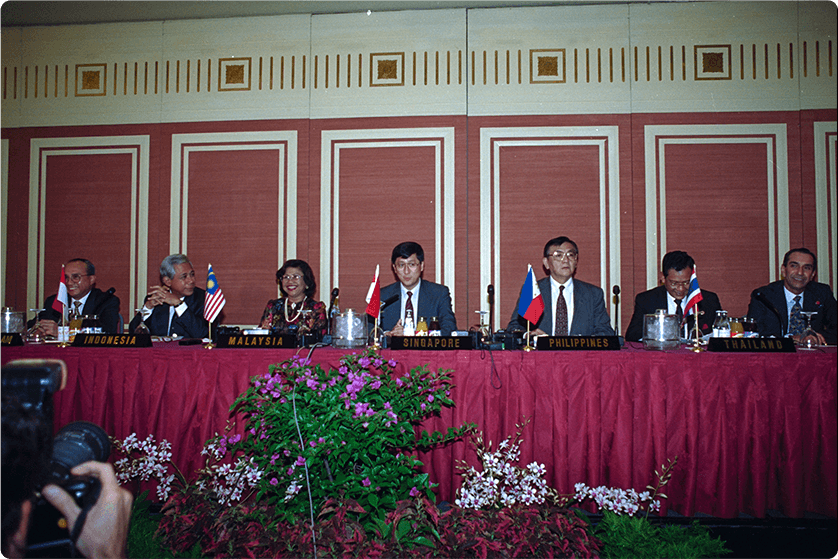
Fourth meeting of Asian Free Trade Area (AFTA) Council and working
dinner. Ministry of Information and the Arts Collection, courtesy of
National Archives of Singapore.
In 1992, six ASEAN members – Brunei, Indonesia, Malaysia, the
Philippines, Singapore and Thailand – signed the ASEAN Free Trade Area
(AFTA) in Singapore. AFTA aimed to further eliminate tariff barriers
among the Southeast Asian countries, integrating the ASEAN economies
into a single production base and creating a regional market of 500
million people.
This led to increasing production efficiencies and long-term
competitiveness, while providing ASEAN consumers a wider choice of
better-quality consumer products.
2007: Towards greater economic integration
ASEAN Economic Community Blueprint 2008-2015
The first ASEAN Economic Community (AEC) Blueprint was adopted by
ASEAN Leaders, serving as a master plan to guide the economic
integration of ASEAN economies.
2009: Streamlining regional trade
ASEAN Trade in Goods Agreement signed
ASEAN Trade in Goods Agreement (ATIGA) aimed to provide a legal
framework to enhance free flow of goods in the region by largely
eliminating tariffs.
2012: Facilitating and protecting regional investments
ASEAN Comprehensive Investment Agreement
The regional investment treaty aimed to create a more liberal,
facilitative, transparent, and competitive investment environment
within ASEAN. Key features include liberalisation of investment rules,
facilitation, protection and transparency measures to make it easier
for investors to operate across ASEAN and attract foreign direct
investment into ASEAN.
2015: ASEAN as a single market
ASEAN Economic Community 2008-2015 realised
The ASEAN Economic Community (AEC) Blueprint 2008-2015 was realised,
advancing ASEAN further towards a single market and production base,
and deepening regional economic integration through the seamless
movement of goods, services, investment and capital in the region.
The next bound of ASEAN’s regional economic integration was launched
through the AEC Blueprint 2016-2025.
2020: Integrating ASEAN’s service sectors
ASEAN Trade in Services Agreement signed
ASEAN Trade in Services Agreement (ATISA) aimed to deepen the
integration of ASEAN’s services sectors, creating a more liberal,
transparent and predictable environment for service suppliers in the
region.
2020: Signing the world’s largest FTA
Regional Comprehensive Economic Partnership signed
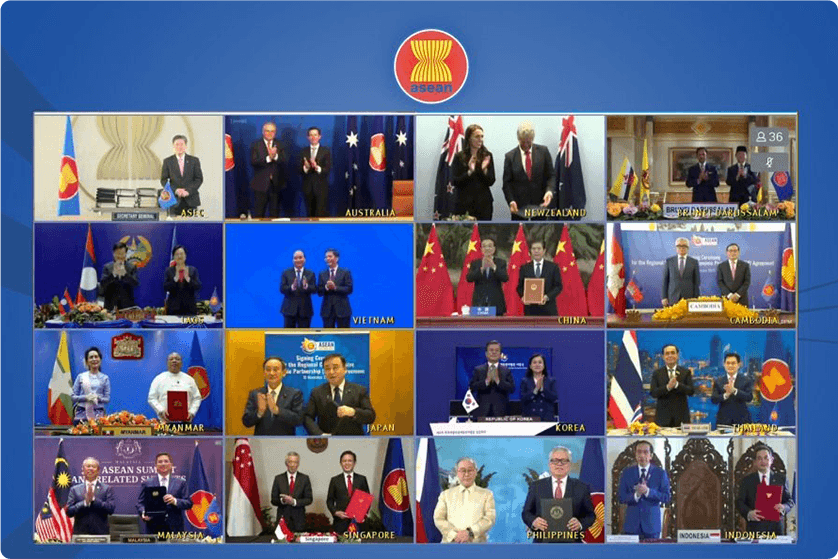
Economic Ministers signing the RCEP on 15 November 2020, witnessed
by Leaders.
The Regional Comprehensive Economic Partnership (RCEP) involves ASEAN
member states alongside five major economies: Australia, China, Japan,
Republic of Korea, and New Zealand. More than just a trade deal, the
RCEP serves as a strategic signal of RCEP participating countries’
shared commitment to keeping markets open and integrated in the Asia
Pacific.
It is the world’s largest Free Trade Agreement, accounting for around
30% of the global Gross Domestic Product (GDP) and a third of the
world’s population.
2025: The next phase of economic integration
Upgraded ATIGA signed and ASEAN Economic Community Strategic Plan
(2026 - 2030) launched
The upgraded ATIGA was signed in 2025, marking a major modernisation
of the Agreement to strengthen regional supply chains, establish a
crisis response framework, improve regulatory transparency, and
advance digitalisation to enhance intra-regional trade flows.
ASEAN entered its next phase of regional economic integration with the
realisation of AEC Blueprint 2025 and launch of the AEC Strategic Plan
(2026-2030). The first five-year cycle of the AEC Strategic Plan
features a forward-looking agenda, including for businesses to seize
opportunities in emerging areas such as digital and green economies.
2026: The region’s first digital economy agreement
Conclusion and Signing of the ASEAN Digital Economy Framework
Agreement
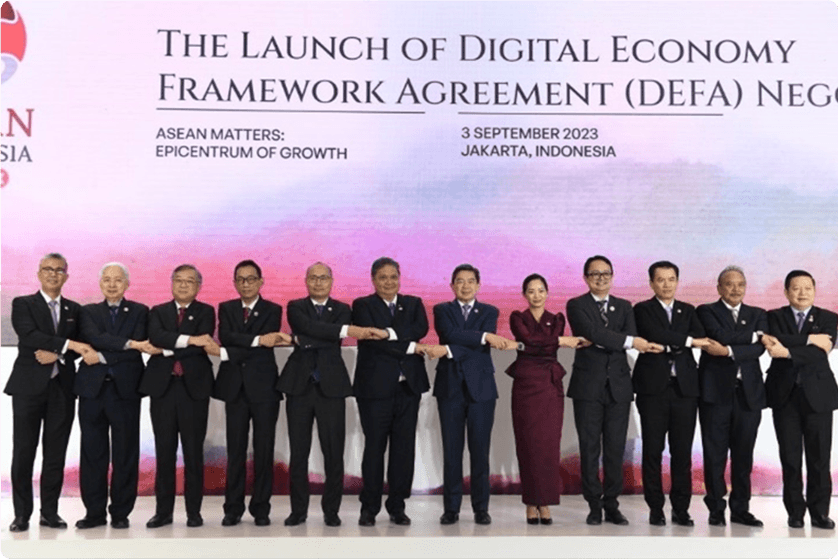
ASEAN Economic Ministers announcing the launch of the ASEAN DEFA
negotiations on 3 September 2023
As the region’s first standalone and most comprehensive digital
economy agreement, the ASEAN Digital Economy Framework Agreement
(ASEAN DEFA) marks a new chapter in ASEAN’s digital economy journey.
Once in force, it will help businesses better access opportunities in
the region through its common rules and frameworks in key areas such
as digital trade, e-commerce and e-payments. It will also support
cooperation in emerging areas such as Artificial Intelligence.
The ASEAN DEFA is expected to be signed at the 49th ASEAN Summit in
November 2026.
The ASEAN Declaration was signed in 1967 so Southeast
Asian countries could foster closer political ties while pooling
together collective resources for economic prosperity. By 2025, the
region’s combined GDP was estimated to have crossed
US$4 trillion.
This remarkable trajectory of economic progress signals great promise
for the future: Southeast Asia is not just part of global markets; it
is actively shaping them.