

Opening doors to new markets: Singapore’s ties with the Pacific Alliance
DEC 17, 2025 | 5-MIN READ
Government officials will never ask you to transfer money or disclose bank log-in details over a phone call.
Call the 24/7 ScamShield Helpline at 1799 if you are unsure if something is a scam.


NOV 28, 2025 | 5-MIN READ
No one would expect old shipping containers to become stylish, eco-friendly hotels – but that’s exactly what Seah Liang Chiang set out to prove. Inspired in part by a popular Netflix series “Tiny House Nation”, Seah saw an opportunity to reimagine urban hospitality by offering unique stay experiences in compact, upcycled containers – a new business venture he would call Tiny Pod. As it turned out, he was in the right place at the right time.
Every entrepreneur knows the real challenge often begins after the idea – it can be a nightmare navigating the maze of approvals, permits and paperwork that can stall even the best of concepts. But in Singapore, the process is getting smoother and faster. To cut through red tape and spark innovation, Singapore has introduced initiatives and frameworks to reduce friction and encourage entrepreneurial endeavours.
As a self-described “serial entrepreneur”, Seah was aware that Singapore had the frameworks and governing bodies to support entrepreneurs with innovative ideas like himself. When he reached out to the Pro-Enterprise Panel (PEP) of the Ministry of Trade & Industry (MTI) – which works to review rules and regulations that might hinder innovation – about Tiny Pod, he was surprised to receive a reply within a week. PEP expressed openness to his business concept and offered to connect him with relevant agencies. The supportive reply was encouraging to the entrepreneur, who was accustomed to facing rejections in his ventures.
From there, Seah applied for Tiny Pod through the First Mover Framework of the PEP, which gives entrepreneurs with innovative business ideas a head start with the use of public land and spaces. Through the framework, pioneering businesses can skip tender processes and enjoy direct allocation of public assets, saving time on paperwork and on waiting for tender results. For Seah, this meant getting assistance in finding potential locations, as well as securing permits and approvals from various statutory boards like the Building & Construction Authority and JTC Corporation.
With PEP’s support, Seah piloted the first Tiny Pod Shipping Container Hotel at LaunchPad @ one-north, JTC’s startup cluster – thanks in part to a system built to say “yes” more often than “no”.
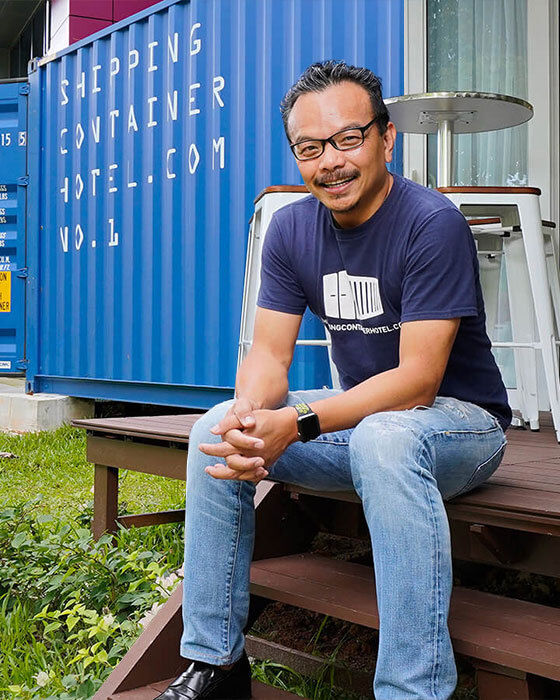
I am heartened to see the shift in mindset. The support I got from the authorities and framework in place, is a clear sign that Singapore is open to new ideas – even bold and unconventional ones.
Seah, Founder and CEO of Tiny Pod
Keeping the rules simple and reducing red tape has always been a priority in Singapore’s pro-business approach. Amid global uncertainty and rising business costs, Singapore has doubled down on this commitment.
An Inter-Ministerial Committee for Pro-Enterprise Rules Review, led by Deputy Prime Minister Gan Kim Yong, was established in 2024 to accelerate efforts to ensure Singapore’s continued business competitiveness. The SME Pro-Enterprise Office (SME PEO) was then established in March 2025 within EnterpriseSG, serving as a central entity to help businesses lower transaction and regulatory costs.
DCA Architects is one such firm that experienced first-hand improvement in streamlined regulatory approvals. They were among the pioneer participants of CORENET X, a one-stop integrated digital solution that streamlines the submission and approval process of building works in Singapore. Before this, a real estate project had to be submitted to each government authority individually, and feedback could be conflicting across reviewers, or returned at different times. CORENET X brings about time and cost savings, offering single-access approvals, and enabling construction to proceed with greater confidence and certainty.

We saw it as the future of submissions.
Khoo, Founder of DCA Architects
Only one model of the building proposal was required to be submitted by DCA Architects, enabling all involved agencies to review it collectively and provide a unified response. This streamlined process is estimated to reduce overall regulatory approval time by 20%. Their recent Promenade Peak project with Allgreen Properties Pte Ltd was able to secure Construction Gateway approval in under 11 months from land tender award.
With CORENET X, project proposals that could have required 20+ touchpoints for review now only have to go through 3 key sequential submission gateways.
Since the soft launch on 18 December 2023, CORENET X has made good progress – more than 60 projects of various building typologies, involving a total of 100 firms, have been voluntarily submitted through the platform. CORENET X continues to be enhanced regularly to improve the user experience, based on feedback and insights from early adopters.
In the case of CORENET X, BCA involved industry practitioners like DCA Architects from the beginning to gather feedback, co-ideate and co-create. Through sandbox trials using real-life projects, industry practitioners were able to test workflows, and co-create solutions that are both practical and beneficial for users.
For entrepreneurs who want to apply for the First Mover Framework – just like Seah did with Tiny Pod – the PEP provides step-by-step guides and FAQs on their website to facilitate their proposals. Businesses requiring support to navigate regulations that span multiple government agencies, or those in emerging sectors where regulations are still being developed, can approach SME PEO for assistance.
“A lot of entrepreneurs want to start their business here,” Seah says. “We can be welcoming in making Singapore the launchpad for startups into the region.”
By giving entrepreneurs the green light to test unconventional, new ideas and bring fresh ventures to life, Singapore is doing more than just cutting red tape – it is building a better system for bold, future-ready enterprises.