“Be user number one”
Carousell co-founder Marcus Tan on building start-ups that last – and scaling Singapore’s next champions
APR 15, 2026
|
5-MIN
READ
“Be user number one”
Marcus Tan’s advice to aspiring founders is deceptively simple. “Find a
problem you want to solve for yourself – then build a solution. You should
be user number one.”
To Tan, startup founders often obsess over a specific solution or
technology. But entrepreneurship should be more about addressing real
customer needs, not just building products. This is why founders who are
“problem-first, rather than solution-first”, in Tan’s words, are likelier to
succeed – especially if “it’s a problem they are genuinely passionate about,
something that irritates them on a daily basis.”
Starting with the problem, not the solution
Tan knows the power of this mindset all too well. When he and his
co-founders launched Carousell in 2012, mobile marketplaces were still new
to Southeast Asia, and trust in peer-to-peer transactions was far from
established. The founding team wanted to make buying and selling second-hand
items online simpler and more intuitive – solving a pain point they
experienced themselves. Over time, that user-first approach helped Carousell
evolve from a student project into a regional recommerce platform used by
millions.
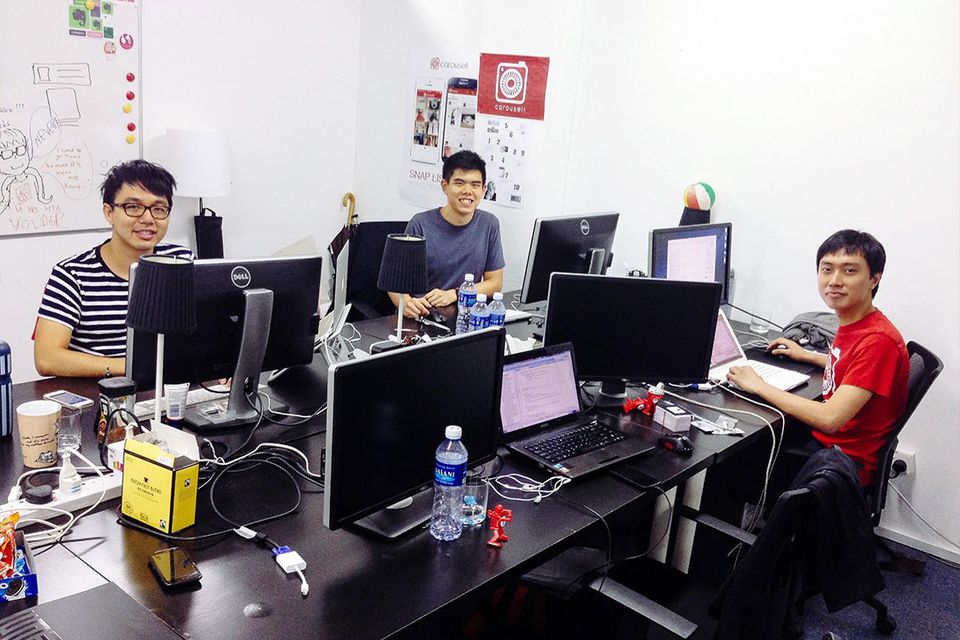
Tan and his co-founders in Carousell's early days.
As Carousell’s user base matured, their needs shifted from second-hand books
and clothes to higher-value categories such as cars and luxury bags. With
these categories came a new insight: trust mattered more than convenience.
Through pop-up events and platform interactions, the team also observed that
physical touchpoints could strengthen trust and improve the buying
experience. This led to Carousell’s expansion into omnichannel recommerce,
including store openings at The Centrepoint (Carousell Luxury) and Chinatown
Point (CarousellMOBILE).
Rather than diversifying for growth alone, the move represented an
adaptation to changing user expectations – a reminder that scaling
successfully often means evolving alongside users.
A maturing ecosystem – with room to grow
That same principle applies to Singapore’s start-up landscape.
According to Tan, Singapore is “world-class” at building the early stages of
the pipeline: attracting venture capital, providing government support, and
nurturing globally ready talent. He should know – from JTC’s LaunchPad to
the NUS Enterprise community, Singapore provided the infrastructure and
networks that allowed him and his co-founders to test ideas quickly.
Today, however, “the challenge is no longer just about helping more people
start companies,” he says. “It's about helping our next generation of
start-ups scale globally – by building resilient, high-value business models
that can punch above their weight on the world stage.”
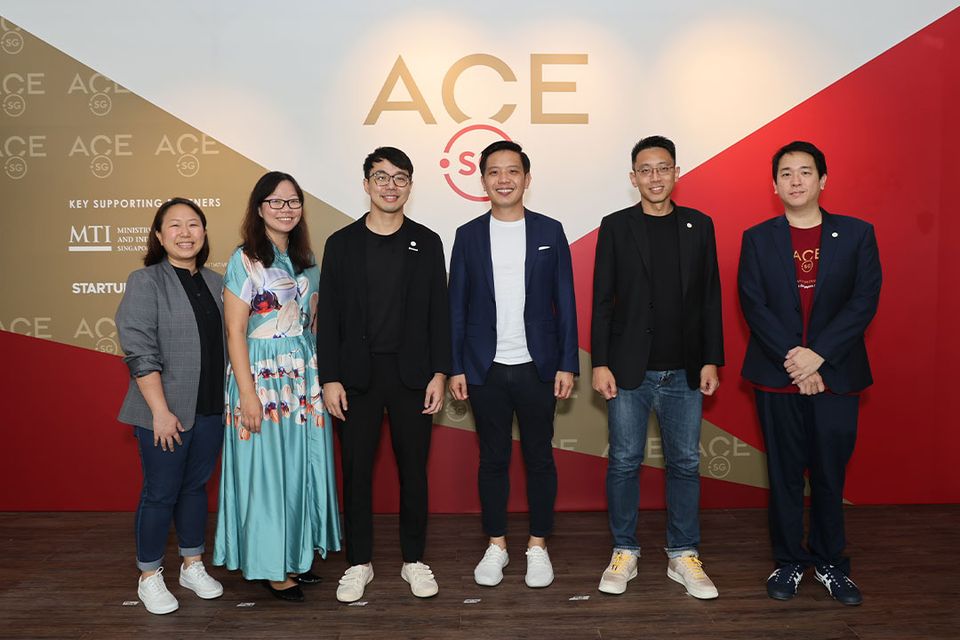
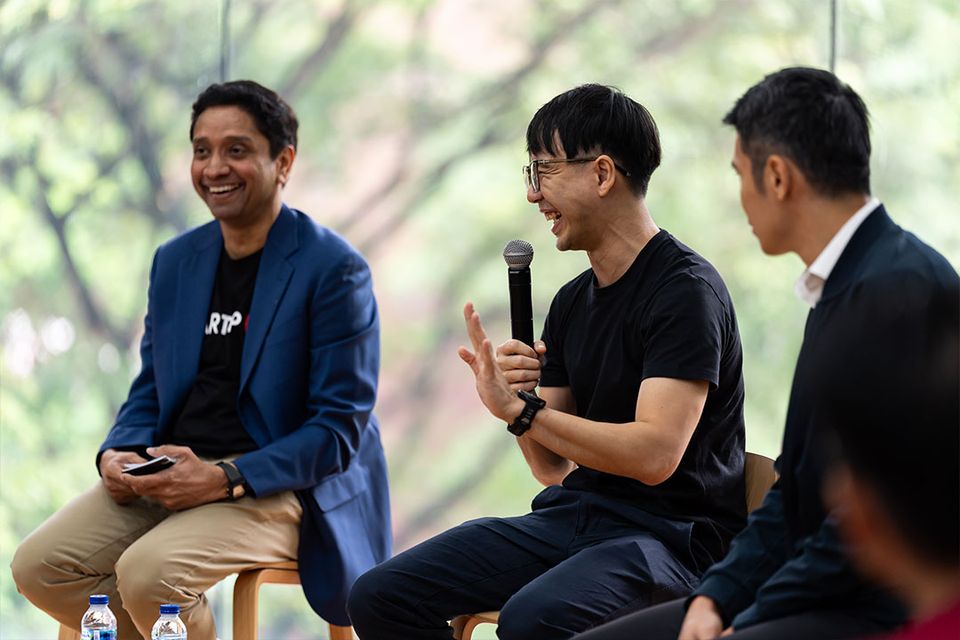
ACE.SG’s closed-door dialogue session with Minister of State, Ministry
of Trade and Industry and Ministry of Culture, Community and Youth Alvin
Tan.
That’s no small task, as rapid technological disruption, shifting global
supply chains and geopolitical fragmentation have made scaling companies
more complex – even as advances such as artificial intelligence create new
opportunities.
One area where Singapore still has room to grow is risk appetite.
Investors and stakeholders often wait for companies to prove themselves
before offering strong backing – but without this backing, start-ups often
do not have the resources to scale and succeed. “We need a fundamental
shift toward taking calculated risks on founders who dream big,” he says.
“And accepting that failure is often just a valuable data point for
learning, rather than a dead end.”
Receiving from the ecosystem – and paying it forward
But successful founders have a role to play too. Tan believes that having
benefitted from Singapore’s start-up ecosystem, founders have a
responsibility to contribute to its future.
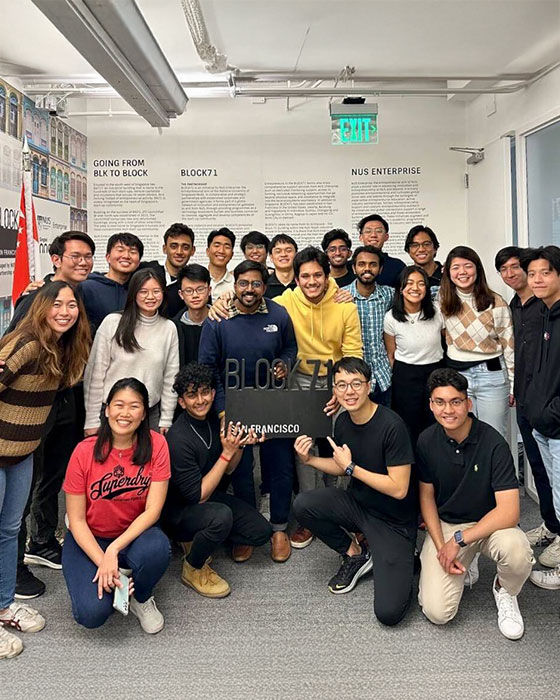
Tan with NUS Overseas Colleges (NOC) students at BLOCK71, a global
entrepreneurial hub by NUS Enterprise.
We often say we are a product of this ecosystem. That means we have a
responsibility to nurture the next generation.
He also stresses the need for more platforms where capital and expertise can
be fed back into the ecosystem – so the next wave of founders do not just
start companies, but scale them with the right support, context and honest
guidance about what growth demands. The goal is a virtuous cycle in which
knowledge compounds alongside capital.
Following his own advice, Tan is trying to be part of the solution. His
conviction led him to take on the role of Deputy Chairman of the Action
Community for Entrepreneurship (ACE.SG, a non-profit trade association for
start-ups in Singapore), and to join the Singapore government’s Economic
Strategy Review (ESR) Entrepreneurship Committee, formed in 2025. In both
roles, he focuses on ways to help founders scale their start-ups into global
champions.
Start-ups as career launchpads – and where meaningful work begins
Tan is passionate about start-ups because of the unparalleled experience
they give to founders.
Start-ups are effectively a jump-start for your career,” he says. “You
are constantly forced to do things you have never done before, which
builds a unique kind of persistence and courage that you just can’t get
in a traditional classroom.
For Tan, this sense of growth is closely tied to purpose. Over the years,
Carousell has built a deep relationship with a community that uses the
platform to improve their lives. And, by enabling recommerce – extending the
lifespan of goods through buying and selling – Carousell contributes to a
more circular and sustainable economy while creating tangible benefits for
users. Tan says, “Seeing a seller make a living, or a buyer find something
they otherwise could not afford is incredibly motivating.”
Tan at an engagement session for early-stage start-ups with Minister of
State, Ministry of Culture, Community and Youth, and Ministry of
Manpower, Dinesh Vasu Dash.
No perfect plan: just real problems to solve
If all this sounds daunting, or that the stars must be aligned for a
start-up to succeed, Tan says that it doesn’t have to be. In fact, the best
approach for founders-to-be is to start small – and start now.
“Don’t wait for a perfect plan or a huge marketing budget,” he says. “Find a
problem that lacks efficiency, solve it for yourself, then solve it for 100
people and make them incredibly happy.”
Ultimately, like Carousell, enduring companies are built by staying close to
real problems and the people experiencing them – and by having the
discipline to evolve alongside both as the world changes.